














Eyelid Surgery (Blepharoplasty)
Content
Description
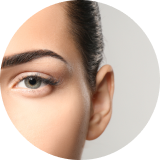
It is said that eyes are mirror to the soul. Over the years as the skin looses its elasticity, excess of skin, puffiness of the upper eyes, bags under the lower eyelid and dark circles occur.
The excess of the skin can hang over eyelashes and thereby narrow the field of vision - this is why the skin excess is called as blepharochalasia (blepharochalasis) and is considered a disease.

Facts
- Local anesthesia
- Outpacient procedure
- Operation lasts 1 hour
- Full recovery after 7 days
Upper and lower eyelid surgery (blepharoplasty) are two different kinds of operation.
- The goal of the upper blepharoplasty is to reduce the excess of the skin hanging down over the eyelishes, smooth out wrinkles and remove fat pockets. Eyes look younger and less tired.
- Lower blepharoplasty smoothes and tightens wrinkles, removes fatty bags and tightens the loose skin.
Eyelid surgery is an outpatient procedure performed in a local anesthesia. Upper and lower blepharoplasty can be done together and also with combined with laser resurfacing and another procedures.
Incisions are made at the upper eye fold (upper blepharoplasty) and on the edge of the lower eyelid (lower blapharoplasty) so the scar is hidden in natural wrinkles and is almost invisible when the eyes are open.
Cooling packs are used for 24 hours after surgery to reduce bruising and swelling.
The tissue around the eyes is very delicate and therefore always swells after surgery, but you will not have vision problems, as your eyes were not operated on.
it is recommended to sleep with your head elevated (use one pillow more) and wear sunglasses to avoid frowning for 7 days.
Swelling disappears on its own within 4 days, stitches are removed after 1 week and bruises can persist for 10 days.