

















Tooth decay (Dental caries treatment)
Content
Description
Tooth decay (caries, dental cavities) is damage to tooth enamel caused by bacteria that break down parts of food (mainly sugar) to form acids. These acids then "etch" (demineralise) the tooth enamel.
- Tooth decay is accompanied by tooth pain (toothache) when biting, tenderness to hot, cold or sweets foods and toothache during the day and night.
- If tooth decay is not treated, it gradually penetrates through the dentin to the pulp and thus damages the entire tooth.
- Tooth decay is very common and affects up to 90% of the population.
- It is important to prevent tooth decay by thorough dental hygiene, to have regular dental check-ups and to have tooth decay treated if it occurs. This will prevent tooth loss.
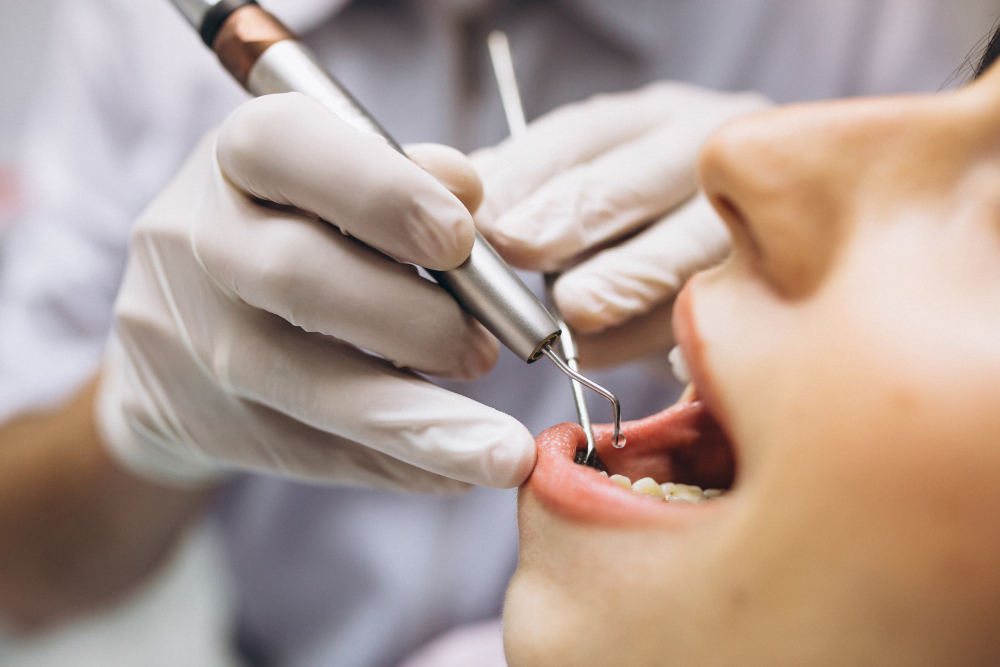
Facts
- Local anesthesia
- Outpatient procedure
- Procedure lasts 30 minutes
- Eat and drink shortly after the procedure
To prevent the formation of dental caries it is important to:
- Brush your teeth twice a day with fluoride toothpaste for at least 2 minutes.
- Floss between your teeth once a day.
- Use an alcohol-free and antimicrobial mouthwash.
- Go to the dentist for regular check-ups.
- Use dental sealants (the dentist places a thin and protective coatings on chewing surfaces of the teeth) while the teeth are still healthy to protect them.
First stages of tooth decay are reversible and can be treated with tooth brushing and dental hygiene, because the damage of the enamel can be remineralized again. Remineralization gels are also available.
We can distinguish five stages of tooth decay:
-
Stage 1. - Demineralization. Plaque bacteria are producing acids and causing loss of minerals in the enamel. You can see small white spots on your tooth.
-
Stage 2. - Enamel decay. Further break down of tooth enamel is creating small cavities. A brownish color occurs.
-
Stage 3. - Dentin decay. The decay has reached dentin, which is underneath the enamel. Dentin is less resistant to acids from bacteria. Toothache, tenderness and pain occur as the nerves are irritaded.
-
Stage 4. - Pulp damage. Pulp is the innermost part of a tooth and it contains nerves and blood vessels. Its destruction is leads to severe pain and swelling.
-
Stage 5. - Abscess formation. The final stage of tooth decay presented with deep destruction of tooth pulp. This stage needs immediate treatment involving antibiotics and tooth extraction.
If a tooth decay occurs an examination by a dentist is necessary.
- Tooth decay can be found on the chewing surfaces, along the edge of the gums or in the spaces between teeth.
- In addition to direct examination a dental x-rays are sometimes very helpful. Laser and fluorescent diagnostics are also used.
Tooth filling.
- Tooth decay is treated by drilling out and replacing the enamel with a filling. It is important to note that the filling is never as strong as the original enamel.
- Originally, amalgam (amalgan filling) was used, which was gray in color (by 2030, amalgam should not be used at all due to the mercury content).
- Today, a composite filling is available, which is white in color, hardens after the use of UV light, and the patient can eat and drink shortly after the procedure.
- Another type of filling is glass ionomer cement, made of silica glass and polyalkenoic acid. It is white in color and contains fluorides.
- Gold and porcelain fillings are used as inlays and onlays sometimes too.
If the damage to the tooth reaches the pulp (stage 4.) a more extensive procedure with cleaning the dental root canals (endodontics) is necessary. The nerve is removed, the dental pulp is drilled and filled with a special filling material (gutta-percha).
If tooth decay has damaged a large part of the tooth, but the root has remained alive, it is possible to put on a dental crown.
In some cases, the tooth cannot be saved and tooth extraction is necessary.
An unpleasant and dangerous complication is the spread of infection with the formation of a tooth abscess (stage 5.).
It is already possible to eat and drink shortly after the treatment of tooth decay with a filling.
The presence of tooth decay should be a warning to us that oral hygiene is not sufficient.
You must continue to take good care of yout teeth, because so-called secondary tooth decay can also occur - sometimes tooth decay can occur on a tooth that has already been treated with a filling.
Related procedures
 Dentistry
- Preventive dental care
- Dental hygiene
- Teeth whitening (Bleaching)
- Dental pulp and dental root treatment (Endodontics)
- Dental braces (Orthodontic cases)
- Dentures (False teeth)
- Dental crowns and Dental bridges and Veneers
- Dental Implants
- Tooth extraction
- Dental X-rays
- Dental Treatment Under General Anesthesia
- Periodontitis (periodontal disease)